
Why we were there?
The Prompt Engineering Conference is the first event in the world that is entirely about prompt engineering. The new field that forms the bridge between humans and AI.
Researchers, developers, linguists, and designers from around the world came together to talk about one thing: how to make AI better understand what we mean.
From sessions about prompting in production environments to experiments with context layers and generative agents. The event focused on everything that is needed to grow from separate AI experiments to mature, practical applications. That is exactly why we wanted to go there as Blis. Prompt engineering isn't just a hype. It is a skill that will determine the future of software development. And we wanted to know: are we doing it well, or can we do it smarter?
From Canary Wharf to the Future
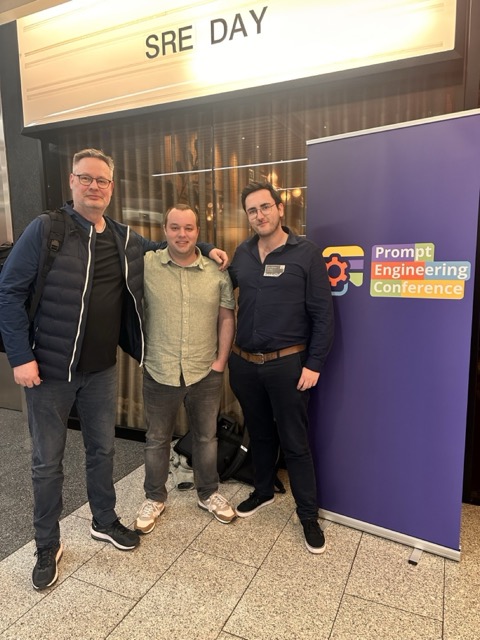
After an early flight and a surprisingly smooth ride through the gleaming heart of Canary Wharf, we arrived at the conference center. So it's a movie theater.
We were far too early and were the first to get our badges. The first conclusion of the day: the AI community is a lot more relaxed than you think.
While we wondered if anyone would even show up, the first participants slowly trickled in. In no time, we were having a cup of coffee with Don Cooke, an AI enthusiast from the education sector. A conversation that immediately made it clear: the impact of generative AI goes far beyond tech alone.
What makes prompt engineering so special?
The conference focused on one theme: the art of talking to AI. Or rather, building structures that allow humans and AI to truly understand each other. Prompt engineering isn't just a skill. It is the bridge between human intent and machine intelligence.
We saw sessions with Oxford researchers, Microsoft engineers and Amazon teams. And to be honest: we were sometimes there with mixed feelings. While others explained how to use context engineering to get reliable AI output, we mostly thought, “Hey, but we've been doing that at Blis for months.”
That may sound a bit arrogant, but it was mostly a confirmation. The way we train, structure and test our AI agents is surprisingly well suited to the methods that are presented as best practice worldwide.
AI makes mistakes with trust
An insight that stuck: AI's biggest pitfall is not that it makes mistakes, but that it does so with conviction. That is why prompt engineering is not only a technical skill, but also a matter of sharp thinking, testing and validation. That's where our strength lies at Blis. We don't just build with AI, we design the process around it.Whether it's a chatbot, a generative test agent, or an AI that reviews code. Success depends on the quality of the context you provide to the system. And that starts with humans.
From single prompts to mature workflows
What we noticed is that many organizations are still in the experimental phase. They play with prompts and try out separate tools, but aren't building structural AI/Agentic workflows yet. At Blis, we are past that by now. We work AI-first. This means that AI is a structural part of our development processes. Not as a tool, but as team of extremely smart colleagues. In particular, the conference confirmed that this approach works. The future of software development does not lie in separate experiments, but in designing complete AI ecosystems where humans and machines reinforce each other.
Finally: go home with a full head and a full stomach
After eight sessions, excellent catering, and a few tough discussions about frameworks and layers of context, our head was full of ideas. And our stomachs, too. No time for extensive networking (IT people remain IT professionals 😉). So with a taxi full of insights and suitcases, we drove back to London City Airport.
Just wait for a delayed flight, a fast burger at Schiphol and then back home at 01:00. Ready for the daily next morning.
What sticks
The Prompt Engineering Conference showed that AI is maturing rapidly. And that the real advantage is not in tools, but in how we communicate with them. For us, it was primarily a reassuring conclusion: we are on the right track.
The world is now discovering what we at Blis already do every day: working AI-first, with a focus on quality, context and human validation.
FAQ
Frequently asked questions
We'd be happy to answer those right away. If your question isn't listed, please feel free to contact us.